

State Data Agency (Statistics Lithuania) – a Strategic Partner in Establishing Lithuania’s Artificial Intelligence Competence and Technology Center

Lithuania is set to establish an artificial intelligence center. The European Commission has allocated funding for LitAI – the Artificial Intelligence Competence and Technology Center.
On 27 June 2025, Vilnius University (VU) and the Ministry of the Economy and Innovation of the Republic of Lithuania (EIMIN) signed a memorandum of intent to establish the Artificial Intelligence Competence and Technology Center – LitAI (AI Factory). This ambitious project’s consortium includes not only representatives from academia and business but also the State Data Agency (SDA) – the main partner responsible for managing, accessing, and securing national data resources.
“Artificial intelligence progress begins with data – reliable, accessible, and responsibly managed. LitAI is a step toward a mature data ecosystem where the public sector, science, and business create shared value for Lithuania and Europe”, says Dr Jūratė Petrauskienė, Director General of the State Data Agency.
The Backbone of the Data Ecosystem – the State Data Lake
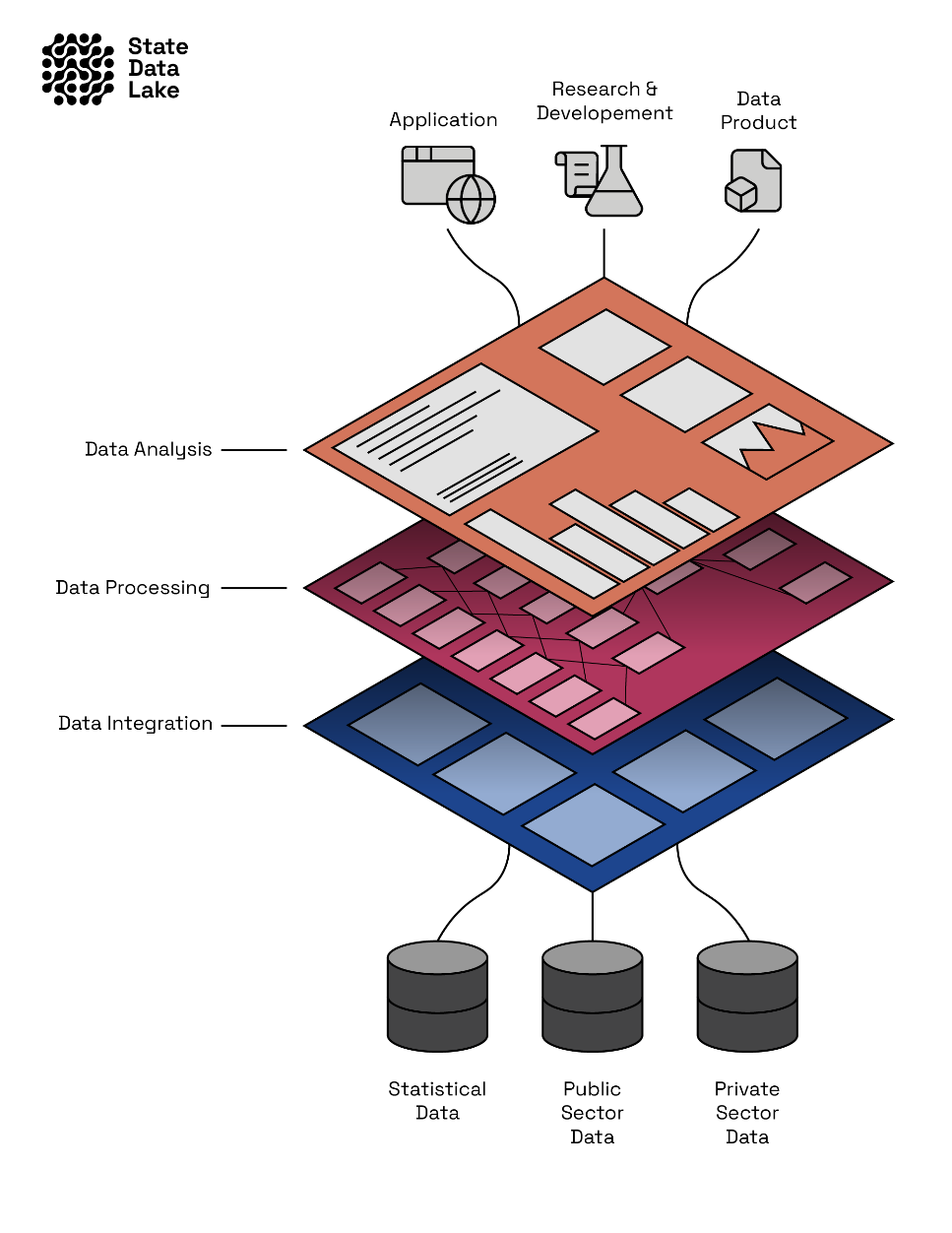
The core of LitAI’s development is the State Data Lake – a platform based on Palantir Foundry, developed and maintained by the State Data Agency since 2023. This infrastructure has already connected nearly 500 government information systems, created over 900 publicly accessible structured tables, and opened up 238 high-value data sets (HVDs). In 2023 alone, 45 secure remote research environments enabled scientists and institutions to work with sensitive health, energy, and transport data without compromising confidentiality.
By integrating hundreds of systems and unlocking high-value data, the State Data Lake becomes a powerful engine for innovation. “LitAI will provide Lithuanian enterprises with a secure and powerful environment to develop artificial intelligence products – a step toward one of the strongest data spaces in the world”, emphasizes Henrikas Krukauskas, Project Manager of the State Data Governance Group (OSP).
In the Future, the LitAI Ecosystem Will Be Organized into Three Layers
- Storage and Computing Resources – a scalable infrastructure that hosts both structured and unstructured data, as well as high-performance computing (HPC) clusters.
- Data Management and Flow Coordination Layer – a centralized metadata catalog, access controls, transformation and anonymization pipelines, aligned with FAIR and DCAT-AP standards.
- User Environments – web portals, visualization dashboards, and AI development and modeling workspaces tailored for users from both the public and private sectors.
Open and Protected Data Threads
Open and protected data threads in Lithuania encompass both public and regulated access to data. Open datasets, continuously updated on the State Data Agency’s open data portal, contributed to Lithuania ranking 7th in the EU Open Data Maturity Index in 2024. At the same time, under the Law on Official Statistics and State Data Governance of the Republic of Lithuania and the Law for Health Data Reuse of the Republic of Lithuania, researchers and innovators are granted licenses to work with anonymized public sector data in secure virtual environments. This data access will be further enhanced through LitAI interfaces, enabling integration into European data spaces and facilitating the exchange of energy, mobility, and health data using advanced technologies, such as federated analytics and Trusted Execution Environments (TEE).
Value for Lithuania and Europe
The estimated value of the LitAI project is around EUR 130 million, and the high-performance computing (HPC) infrastructure at the center is expected to create over 100 highly qualified jobs. The integrated services in data, computing, and expertise will foster the development of next-generation AI products in areas, such as cybersecurity, personalized medicine, green energy, and smart industry.
LitAI is directly included in the National Digital Decade Plan 2024–2030, which envisions sovereign and secure digital public services, cloud-to-edge computing, and collaboration between the public and private sectors. As the data center, the State Data Agency will ensure that all LitAI initiatives comply with the GDPR, the Data Governance Act, and the upcoming AI Act.
Last updated: 13-10-2025
Related news:
Municipal DataLab Is Now Publicly Available to Everyone
On the Wall of the State Data Agency (Statistics Lithuania), the Bukantė Forest Has Grown
New Dashboard Highlights Suicide and Suicide Risk Trends in Lithuania
Successfully Completed ISO 27001 Surveillance Audit at the State Data Agency (Statistics Lithuania)